A portrait of Hillbrow: 30 years of decay and spirit
- jugramk
- Nov 8, 2024
- 9 min read
Updated: Jan 7, 2025
Hillbrow has garnered a reputation over the years for its disparity, violence, and decay. But while streets lie in disarray, some residents have created sanctuaries from the dysfunction.
I sit quietly in the Uber passenger seat. We pass a cement monolith along the steep hill; its walls charred to coal. The midday sun hesitantly peeks beyond the hollow sockets where windows should be, vaguely outlining scattered rubble in the meek light. A bright pink top drifts across my eyeline as I peer into the darkness. Glancing up, I see a line of clothes dangling over the edge of a third-floor windowsill with an array of blankets draped across the bare building – weary eyelids over an emaciated face.
Reaching the bottom of the hill, we turn into Abel Road which connects Berea to Hillbrow. The Uber driver breaks the silence that has so far prevailed. “But why are you going to Hillbrow my friend?!”. Last month, in that same area, a clip went viral of an e-hailing driver being murdered, provoking a member of the mayoral committee for Public Safety Mgcini Tshwaku to vow in a media statement that: “high-density operations are coming in Hillbrow that has been a den of drug dealers and thugs”. As I reach my destination the driver warns: “Be careful, here they’ll kill you for fun.”
The Hillbrow of old: cocktails and cafes
Hillbrow was once a buzzing cosmopolitan known as a cultural hub during the apartheid era. It was iconic for its vibrant nightlife, array of hotels and restaurants, progressive attitudes, and popularity among the youth. With manicured parks, spotless streets, and modern high-rise buildings, Hillbrow resembled an African Manhattan. As Pass Laws and the Group Areas Act were relaxed due to growing civil unrest in the 1980s, Hillbrow became one of Johannesburg’s first deracialized zones.
But as more black residents flocked into the area its white residents fled, blaming an increase of crime and deterioration in the area on the growing black residency. As more buildings emptied, landlords exploited the situation by allowing scores of people to move in at low rates, paving the way for overcrowding and further infrastructure decay, resulting in an exodus of the remaining middle-class population. With the prospect of cheap accommodation within the city centre, Hillbrow became a preferred port of entry for foreign nationals and economic migrants from across South Africa. By the late 1990s, Hillbrow was in a state of severe decline, noted for a lack of basic service delivery, decaying infrastructure, and overcrowded living conditions. Crime and prostitution became lucrative in this densely populated metro. This set the stage for the Hillbrow of today.
Hillbrow today: violence and decay
“If these guys [the municipality] did clean-up operations maybe 20-30 years ago this place would be Manhattan… town was a beautiful place!” bemoans Faizel Khan, a shop owner who has been in Hillbrow for 35 years. He leans on the entrance to his clothing store smoking a cigarette. “The whole infrastructure is rotten!” he yells, stabbing his cigarette towards a puddle of green sludge across the street. “Broken drains, missing manhole covers, and stealing of metal… every structure that had metal in the street is gone!”. This then quickly leads to a rant about theft and drugs plaguing the streets.
Overhearing our conversation, his mother approaches and cuts him off mid-sentence: “They, murdered my son here, right in front of my eyes! The police didn’t even take a statement from me.” A silence grows as Khan finishes his cigarette. He flicks it into the street, takes a deep breath and stares into the distance. “When I was a youngster here, I could smell the Milky Lane in Esselen Street. That’s how smart this place was.” He lights another cigarette as I walk off.
According to the South African Police Service’s first quarter report for the 2024-2025 financial year, Hillbrow ranks 26th nationally and fourth in Gauteng for murders reported as of June 2024. It also has the sixth-highest number of common robberies and 18th highest number of armed robberies reported in the country.
“Community members don’t trust the police. They [the police] work with syndicates in the area. Even when you give information to them they arrest you to collect money, and later disclose to the criminals who gave them that information… those who serve on community policing forums only protect their interests” claims counsellor of Berea Phineas Madisha. Attempts to reach the Hillbrow counsellor were unsuccessful.
It is the middle of the day and groups of boys no older than 20 lurk on every other street corner. “They are staring you down to see if they can rob you. If you look away, that’s how they know you’re scared” says Delron Buthelezi as we walk down Pretoria Street. He works in Hillbrow and has frequented it since the early 2000s. “They have nothing else to do, no job, no school, nothing”.

The streets of Hillbrow are filled with idle youth. Photo: Kabir Jugram
As we walk up the street, cars edge forward from all four directions of an intersection, dipping into crater-like potholes peppering the road. There is no stop sign or traffic light in site. “I used to come watch movies here,” he says, pointing at a faded billboard protruding from a block of flats. In chipped paint across a grid of Perspex, it reads: ‘Movie World: always better on our big reen’. A sheet of Perspex is missing from the centre. A woman stares at me from the cracked window behind it, her child pressed tightly to her chest.
In the wake of the Usindiso building fire which claimed 77 lives in August last year, the City of Joburg (CoJ) launched a series of inspections into hijacked buildings across the city. One of the buildings inspected was Vannin Court, a hijacked building on the corner of Pietersen and Quartz Streets. The CoJ declared it a disaster waiting to happen.
The building was initially raided in 2019. A media statement issued by the CoJ at the time read: “More than 300 people live in overcrowded conditions in the decaying building, which smells of urine and animal carcasses and has over time turned into a health hazard, unfit for human habitation.” Its residents simply moved back in a few days after their evictions.
“Most hijacked properties are owned by the government and sectional title schemes which collapsed because a majority of body corporate members have left those properties. The government is also sitting with the problem of providing alternative accommodation in order to evict people” claims counsellor Madisha.
“It’s no longer the Hillbrow of ’96, now they don’t respect human life!” vents Johr Thouhakali, swatting wildly at a fly nestled on his stack of glistening red tomatoes. The air is a stifling cocktail filled with the sounds of whistling vendors and wailing taxis. The aroma of fresh produce tussles with the stench of raw sewage.
Thouhakali has been living in Hillbrow since 1996. He rants about days gone by when he played soccer with other youths and walked carefree in the early hours of the morning.
“Maybe in the kasi [there’s community] but not here… when you suffer you suffer on your own.” He peers at me as he rants, squeezing my shoulder. “In one unit [of a flat] there’s four rooms… in the lounge, there’s two families staying there, separated by a curtain”. He speaks of a man in his building who cooks fresh food every day to lure hungry children into his apartment. He then mutters something about a pregnant 13-year-old. “‘I cannot be giving without receiving’... That’s the mentality here.” He is staring at the sun now, his grip on my shoulder loosened. A fly sits comfortably on his shiny red tomatoes.
No place for kids
Eyes lock on me on every block I pass on Pretoria Street. “Ey Boy! Show me that camera” shouts a man sitting on a plastic chair. As Buthelezi and I march through the street, he comes across a friend just off the main road. Trolleys holding big pots of rice line the one side of the road while the other is a mosaic of rubbish. Four teenagers huddle over a rolling paper on the curb.
“My friend wants to ask you about Hillbrow, he’s a journalist,” says Buthelezi to a Rastafarian standing over one of the trolleys. “He must put that camera away then” the rasta replies. As I do, one of the boys from across the streets heads towards me. “What are you shooting?!” he yells, not even checking for cars. Within seconds he reaches for my neck, pulling the camera. “Go take pictures of the white man, he’s a model!”. Buthelezi tries to prize him off me. “I’m not that model!”
I elbow him in the stomach and break free. Buthelezi and his friend now stand between us. He glares at me with bloodshot eyes and raw flesh flaring from his lips. As I meet his glare, he quickly averts his eyes. A hand taps my shoulder from behind: “Just go man. You’ll die for nothing”.
Bruce Dube sits under a tent in a plaza promoting funeral coverage. He has been living in Hillbrow for over ten years but has sent his children to live with their grandparents outside the city. For him, the crime, alienation, and trauma of life in Hillbrow is overwhelming. “You will fail them [your kids]. It’s better you take them somewhere else so they can see a life different from this one, it’s not favourable for growing kids”.

Vice, chaos, business, and youth intermingle in the streets of Hillbrow daily. Photo: Kabir Jugram
Raising Champions
But children do live here. As I walk down Ockerse Street, a schoolgirl waddles up the road holding her little sister’s hand, both in uniforms. The smaller one trips and lands on her face. She begins wailing, and a lady selling sweets on the sidewalk gives her a packet of chips to calm her tears.
In a research paper on the importance of social cohesion, Gillian Eagle (a professor of psychology at the University of Witwatersrand) speaks of Continuous Traumatic Stress (CTS). CTS refers to environments where trauma (in the form of physical and structural violence) is part of daily life. In such environments, the source of trauma is unknown since anyone in the area is a possible threat. As a result, constant paranoia fosters either social withdrawal or aggressive personas as a defence mechanism.

Violence can be repurposed towards positive growth through communal spaces such as sports clubs. Photo: Kabir Jugram
Both Eagle and popular research on urban violence therefore enshrine community spaces as crucial in combatting the negative effects of marginal conditions. Communal spaces encourage common goals that deter people from criminality and offer a form of empowerment in conditions that do not allow self-realization.
Not surprisingly, social cohesion features prominently in South Africa’s policy discourse. The National Development Plan (NDP) of 2030 was drafted during the Zuma administration with the aim of eliminating poverty and inequality by 2030; and one of its target areas is the creation of a safe, socially cohesive society where citizens aspire towards a common goal of upliftment. It thus promotes the development of community safety centres to counteract violence and alienation.
‘George Khosi’s Boxing Gym’ sits at the bottom of Ockerse Street. Across the street lies a freshly trimmed action soccer pitch brimming with children’s laughter. Thanks to the aid of the Non-Profit ‘Bambisanani Hands of Hope’ and numerous sponsors in the Hillbrow community, George Khosi was able to repurpose an abandoned petrol station into a boxing gym.

George built his gym thanks to the support of non-profit organizations and local sponsors within the Hillbrow community. Photo: Kabir Jugram
As I enter the gym’s courtyard, I am greeted by a line of sniggering children doing jumping jacks. A row of punching bags swings wildly as grown men jab at them. In the boxing ring, a woman shouts instructions at a teenage boy “Jab, cross, hook!”. George is at the entrance sweeping the floor.


George Khosi (pictured on the right) does not just aim to keep kids off the streets. He believes he can breed future champions. Photo: Kabir Jugram
“Welcome home!” he tells me. Khosi was once an aspiring boxer, but his boxing dream died after being critically injured in a home invasion. He now spends his days coaching local youth in the discipline of boxing, his goal not just to keep youth off the streets but also to breed future champions. “In the streets, it’s easier to be a gangster… But we give them [the children] a place to be one, to have joy and enjoy boxing!” For him, sport is the greatest way to resist the dysfunction in the streets. “Sports changes people. If someone can do what I’m doing it can change people. It’s not about money or government. It’s about ourselves… it’s about love”.

George Khosi's Boxing Gym is a safe space not reserved for boxers alone. Photo: Kabir Jugram
As children giggle and swing at boxing bags, an old man sleeps on a couch. Beside him, a schoolboy hunches over his textbook. Two young boys enter the boxing ring and swing wildly at each other until one knocks the other’s headgear off. He starts to cry, and the other boy embraces him tightly. An older boy arrives and pats him on the shoulders “You’ll be alright my boy”.


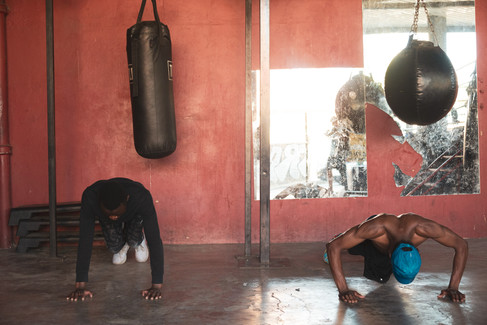
Discipline, order, and respect are a key component of the stability and refuge George's Gym provides. Photos: Kabir Jugram

"Hillbrow's not only for crime. Champions can come from here". Photos: Kabir Jugram
A crayon drawing of George’s face is etched into a corner post of the ring. Above it reads: ‘George is dad’. “Hillbrow’s not only for crime. Champions can come out of here!” Khosi tells me in his gruff voice. The twinkle in his one good eye shimmers against the sun.


Comments